
Navigating Impostor Syndrome in a Culture of Critique
The persistent feeling of being an intellectual fraud is a common, almost predictable, feature of a life in science, and you are in very good company.
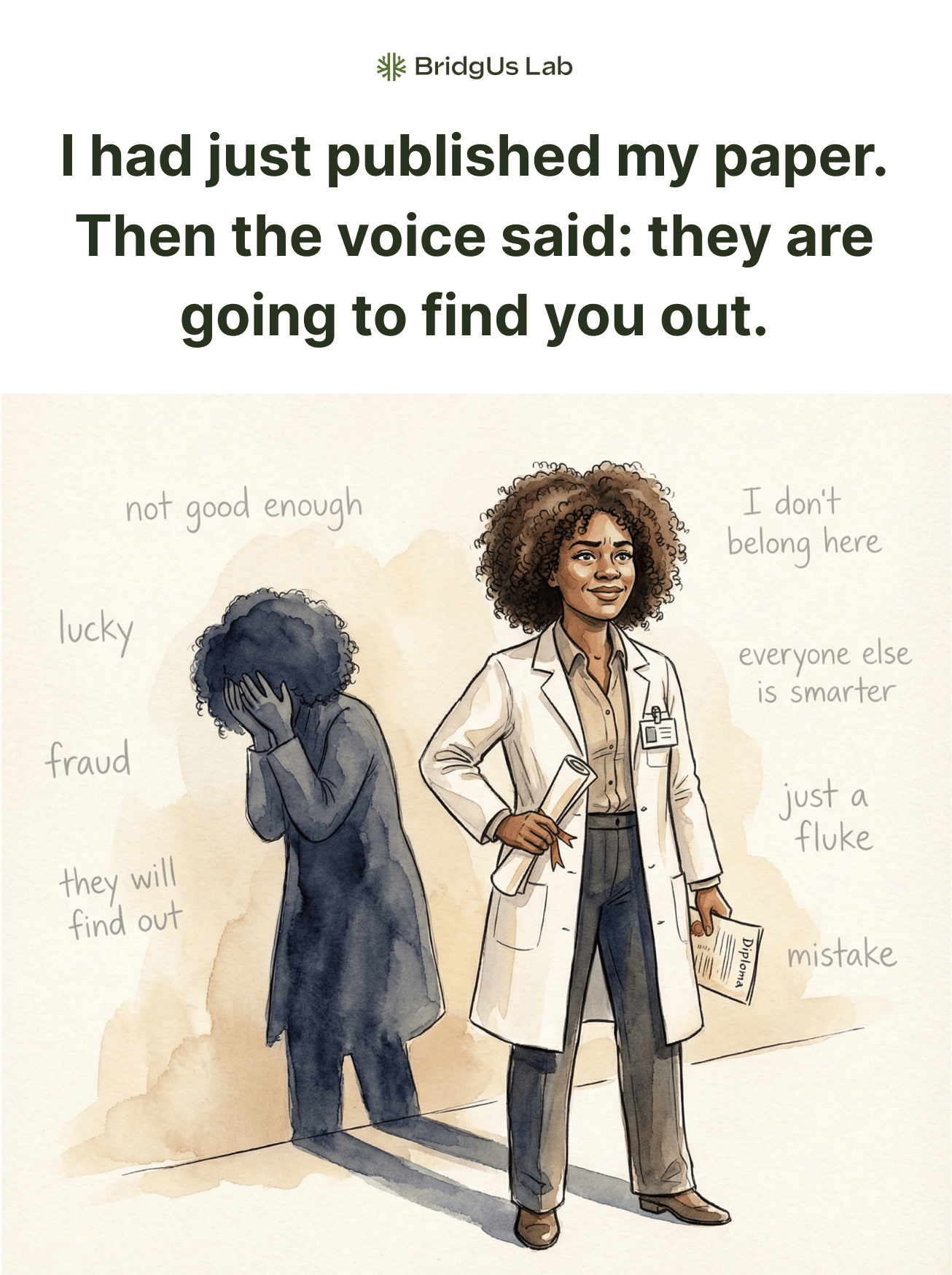
You have just published a paper, received a grant, or presented at a major conference. There is a moment of relief, perhaps even a fleeting sense of accomplishment. But it is quickly followed by a quiet, persistent dread: This is it. This is when they find out I don't really belong here. I've run a game on everybody, and they're going to find me out.
If this internal monologue sounds familiar, you are not alone. This feeling, first termed the "impostor phenomenon" by psychologists Pauline Clance and Suzanne Imes in 1978, is a pervasive experience for high achievers. It is the profound sense that your successes are the result of luck, timing, or deception, rather than your own competence, and that you are in constant danger of being exposed as a fraud.
The Company of Giants
Before dismissing this as a simple lack of confidence, consider the company you keep. The celebrated author and poet Maya Angelou, despite her numerous accolades, confessed, "I have written eleven books, but each time I think, 'Uh oh, they're going to find out now.'" The great naturalist Charles Darwin, after publishing his seminal work On the Origin of Species, reportedly wrote in a letter, "I am very poorly today & very stupid & I hate everybody & everything. One lives only to make blunders."
Perhaps the most powerful anecdote comes from the author Neil Gaiman, who once found himself at a gathering of accomplished individuals. He recounted a conversation with an elderly man who, looking at the room of luminaries, confessed, "I just look at all these people, and I think, what the heck am I doing here? They've made amazing things. I just went where I was sent." Gaiman writes:
“And I said, ‘Yes. But you were the first man on the moon. I think that counts for something.’ And I felt a bit better. Because if Neil Armstrong felt like an imposter, maybe everyone did.”
Academia: A Hothouse for Self-Doubt
While impostor syndrome is widespread, academic and research environments seem uniquely designed to cultivate it. Science is a profession built on critique. The very processes that ensure rigor — peer review, grant applications, viva examinations — are structured around identifying flaws. When only 7% of papers submitted to top journals like Science and Nature are accepted, rejection becomes the norm and success the exception. This constant scrutiny, combined with the reality of working at the very edge of human knowledge, creates a perfect storm for self-doubt.
As organizational psychologist Adam Grant notes, "The experience of impostor syndrome happens when one's level of confidence is below their level of competence." In a field where you are perpetually a student, constantly pushing into the unknown, it is natural for your confidence to lag behind your actual, and growing, expertise.
Reframing the Narrative
The conversation around impostor syndrome is shifting. For years, it was framed as a personal deficit to be overcome. But as researcher and author Brené Brown critically asks, is it fair to label an individual's feelings of not belonging as a "syndrome" when they may be a rational response to a flawed or exclusionary culture? She challenges the narrative:
"When I'm struggling to belong because of the culture that you've built, you tell me, 'Oh, you poor thing, you've got impostor syndrome.'"
This perspective invites a crucial shift. What if feeling like an impostor is not a sign that you are broken, but a sign that you are a thoughtful, conscientious person in a demanding field? Adam Grant suggests exactly this, reframing the feeling as a potential advantage: "Impostor syndrome is not a clue that you're unqualified. It's a sign of hidden potential." It suggests you have the humility to recognize the limits of your knowledge and the drive to improve — both hallmarks of a good scientist.
From Fraud to Fellow Traveler
Understanding impostor syndrome does not magically make it disappear. The goal is not to eliminate the feeling, but to change our relationship with it. It is to recognize the voice of the inner critic for what it is — a defense mechanism, not an objective assessment of reality.
It means acknowledging the feeling, remembering the company of giants like Angelou and Armstrong, and understanding the systemic pressures that feed it. It means separating the feeling of being a fraud from the fact of your accomplishments. You are not an impostor. You are a researcher, a fellow traveler on the complex, challenging, and deeply rewarding path of scientific discovery. And on that path, a little self-doubt is not a sign of weakness; it is a sign that you are taking the journey seriously.
BridgUs Lab is preparing to launch its first certified leadership development course designed specifically for researchers. To receive early information and updates about enrollment, subscribe to our newsletter here and on LinkedIn.
Subscribe on LinkedIn https://www.linkedin.com/build-relation/newsletter-follow?entityUrn=6903084139655102464